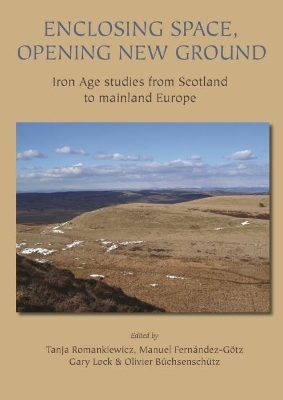
Enclosing Space, Opening New Ground
Oxbow Books (Verlag)
978-1-78925-201-9 (ISBN)
- Titel z.Zt. nicht lieferbar
- Versandkostenfrei
- Auch auf Rechnung
- Artikel merken
Enclosures are among the most widely distributed features of the European Iron Age. From fortifications to field systems, they demarcate territories and settlements, sanctuaries and central places, burials and ancestral grounds. This dividing of the physical and the mental landscape between an `inside' and an `outside' is investigated anew in a series of essays by some of the leading scholars on the topic.
The contributions cover new ground, from Scotland to Spain, between France and the Eurasian steppe, on how concepts and communities were created as well as exploring specific aspects and broader notions of how humans marked, bounded and guarded landscapes in order to connect across space and time. A recurring theme considers how Iron Age enclosures created, curated, formed or deconstructed memory and identity, and how by enclosing space, these communities opened links to an earlier past in order to understand or express their Iron Age presence. In this way, the contributions examine perspectives that are of wider relevance for related themes in different periods.
Tanja Romankiewicz is a Research Fellow at the School of History, Classics and Archaeology at the University of Edinburgh. Developing from her PhD on the complex roundhouses of the Scottish Iron Age, supervised by Ian Ralston, she currently investigates prehistoric and Roman architectures more widely across northwest Europe, funded by the Leverhulme Trust. Manuel Fernandez-Goetz is Chancellor's Fellow in Archaeology at the University of Edinburgh. His main research intterests are Iron Age societies in central and western Europe and the archaeology of identities from a theoretical perspective. This research has resulted in numerous publications relating to the Iron Age of the Iberian Peninsula, northeast Gaul and southern Germany, including Identity and Power: The transformation of Iron Age societies in northeast Gaul (2014). Gary Lock is Emeritus Professor of Archaeology at the University of Oxford. His research interests include computer applications and quantitative methods in archaeology especially Geographical Information Systems, their application and theoretical aspects (current interests are modelling visibility and movement). Olivier Buchsenschutz is one of France's pre-eminent scholars on the Iron Age and has been Director of Research at CNRS, the French national centre of scientific research. He has worked on some of the most famous Iron Age enclosed sites in France, in particular the oppida sites at Bibracte and Bourges.
Tabula gratulatoria
Introduction: Enclosing space and opening new ground in Iron Age studies: An introduction
Tanja Romankiewicz, Manuel Fernandez-Goetz, Gary Lock & Olivier Buchsenschutz
Bibliography of Professor Ian B. M. Ralston
Tanja Romankiewicz, Manuel Fernandez-Goetz, Gary Lock & Olivier Buchsenschutz
BLOCK 1: BUILDING ENCLOSURES
1. Does fortifi ed always equate to defensive? Some thoughts on the fortifi cation systems of the Glauberg hillfort
Axel G. Posluschny
2. De Architectura Celtica: declinaisons insolites de Murus Gallicus
Philippe Barral & Stephan Fichtl, avec Vincent Guichard, Jean-Paul Guillaumet, Martine Joly, Pierre Nouvel & Matthieu Thivet
3. Julius Caesar's assault ramp at the Oppidum of Avaricum in 52 BC
Sophie Krausz
4. How many hillforts are there in Scotland? Revisited
Stratford Halliday
BLOCK 2: CREATING SETTLEMENT COMMUNITIES
5. The hillfort on Mount Ipf: A centre of power during the Bronze and Iron Ages in southern Germany
Rudiger Krause
6. Oram's Arbour, Winchester: A new interpretation
John Collis
7. A new look at the Late Prehistoric settlement patterns of the Forth Valley
Murray Cook, Therese McCormick, Jennifer McAlpine, Ross Greenshields, Gordon Cook & Andrew McLean
8. Enclosure, autonomy and anarchy in Iron Age Scotland
Ian Armit
9. Exploring settlement dynamics through radiocarbon dating
W. Derek Hamilton &Colin Haselgrove
10. Oppida in Britain in the face of the Roman conquest
David J. Breeze
BLOCK 3: MARKING LANDSCAPES THROUGH TIME
11. Atlantic zone hillforts with up-right stone rows and their relationship with coastal routes
Luis Berrocal-Rangel, Pablo Paniego & Lucia Ruano
12. Making mounds: monuments in Eurasian prehistory
Chris Gosden, Peter Hommel & Courtney Nimura
13. Urbanism and identity in Celtic Iberia. What did it mean to be a Vetton, Vaccaean or Carpetanian in Late Iron Age oppida?
Jesus R. Alvarez-Sanchis & Gonzalo Ruiz Zapatero
14. L'enclos comme expression du pouvoir des aristocrates sur la campagne
Olivier Buchsenschutz
15. Memoryscapes in Late Iron Age Northern Gaul: Warfare and sacrifi ce from Ribemont to Titelberg
David Rose & Manuel Fernandez-Goetz
Appendix
| Erscheinungsdatum | 16.01.2019 |
|---|---|
| Zusatzinfo | b/w |
| Verlagsort | Oxford |
| Sprache | englisch |
| Maße | 220 x 280 mm |
| Themenwelt | Geisteswissenschaften ► Archäologie |
| Geschichte ► Allgemeine Geschichte ► Vor- und Frühgeschichte | |
| Geisteswissenschaften ► Geschichte ► Regional- / Ländergeschichte | |
| ISBN-10 | 1-78925-201-6 / 1789252016 |
| ISBN-13 | 978-1-78925-201-9 / 9781789252019 |
| Zustand | Neuware |
| Informationen gemäß Produktsicherheitsverordnung (GPSR) | |
| Haben Sie eine Frage zum Produkt? |
aus dem Bereich