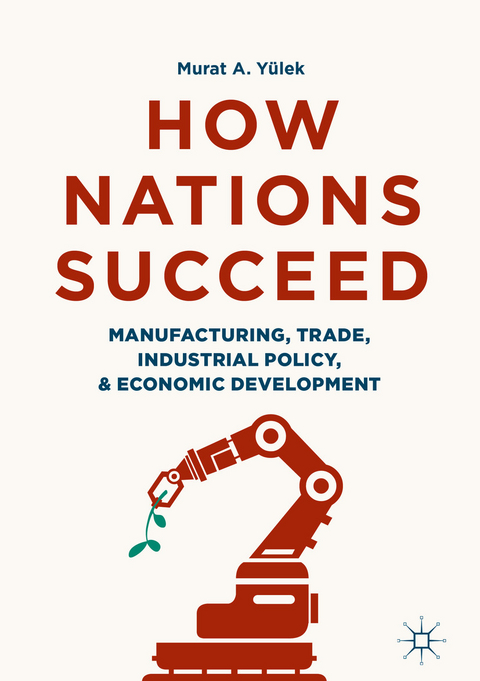
How Nations Succeed: Manufacturing, Trade, Industrial Policy, and Economic Development (eBook)
284 Seiten
Springer Singapore (Verlag)
978-981-13-0568-9 (ISBN)
This book assesses developmental experience in different countries as well as British expansion following the industrial revolution from a developmental perspective. It explains why some nations are rich and others are poor, and discusses how manufacturing made economies flourish and spur economic development. It explains how today's governments can design and implement industrial policy, and how they can determine economically strategic sectors to break out of Low and Middle Income Traps.Closely linked to global trade and (im)balances, industrialization was never an accident. Industrialization explains how some countries experience export-led growth and others import-led slowdowns. Many confuse industrialization with the construction of factory buildings rather than a capacity and skill building process through certain stages. Industrial policy helps countries advance through those stages. Explaining technical concepts in understandable terms, the book discusses the capacity and limits of the developmental state in industrialization and in general in economic development, demonstrating how picking-the-winner type focused industrial policy has worked in different countries. It also discusses how industrial policy and science, technology and innovation policies should be sequenced for best results.
Murat A. Yülek is the Director of the Centre for Industrial Policy and Development at Istanbul Commerce University and has also taught at Georgetown University. A widely published former IMF economist and a corporate executive, he has had responsibilities that include corporate finance, development and macroeconomic policy in various countries.
A Note on Conventions Used 6
Acknowledgements 8
Contents 10
Abbreviations 17
List of Figures 19
List of Tables 21
Prologue 23
Part I 27
Chapter 1: The Old World Order: Trade Before the Empires on which the Sun Never Set 30
1.1 Eurasian Trade: Reverse Flows of Merchandise from Asia Versus Gold from Europe 30
1.2 Economics and Commerce in Medieval Europe Prior to European Geographical Explorations 32
1.3 The Silk Road and the Spice Route in Medieval Times: The Mediterranean as Part of Global Trade 32
1.4 Venice Reaches the Zenith of Power in the Mediterranean 34
References 37
Chapter 2: The Pre-Industrial New World Order: Colonial Empires on Which the Sun Never Set 38
2.1 Winners, Losers, and Definite Losers of the New World Order 38
2.2 For Spices and Christians: Portuguese Trade Deficit and Colonization 40
Portugal’s Global Expansion 41
2.3 Spanish Expansion into the Americas 44
2.4 The Colonizer of the New Age: Britain’s Ascendance to a Global Power 46
Britain’s Merchant Adventurers: Pioneers of British Global Expansion 46
The First Phase of English Global Expansion: Colonization of North America 48
The Joint Stock Company, the Crown’s Charter, and the Colonies 50
The Second Phase of British Global Expansion: The British East India Company and the Colonization of India 52
Britain Gaining Full Control of India 54
The Dutch: England’s Friend and Also Foe in the Quest for Domination of Global Trade in the Seventeenth Century 56
The Simple Economics of the British Colonies in America 59
References 62
Chapter 3: British Colonial Empire and Industrial Policy: Protection, Monopolized Trade, and Industrialization 63
3.1 Britain’s Trade Prior to the Industrial Revolution 64
3.2 The Industrial Revolution and the Expansion of Trade in the Eighteenth Century 67
3.3 British Industrial Policies as the Driver of British Industrialization 69
Inviting Textile Masters to Britain: Learning and Technology Transfer Before the Industrial Revolution 71
Import Substitution and Infant Industry in the Fourteenth Century: Shifting England’s Exports from Raw Wool to Textiles 73
British Navigation Acts: Development of British Shipping and Shipbuilding Industries 75
Monopolizing the International Trade of Colonies: Running Current Account Surpluses by Prohibiting Manufacturing in the Colonies 76
The Triangular Trade 78
3.4 India Before and After British Invasion 79
Manufacturing ‘Good’ Indians 82
3.5 The Story of Cotton: Slaves, India, and British Industrial Revolution 84
Banning Imports of Efficient Indian Cotton Textiles 85
Turning Britain into a Cotton Textiles Manufacturer 86
USA Becomes the Source of Raw Cotton 87
Cotton: The Critical Commodity 88
Cotton and Slavery 90
3.6 Free Trade Agreements, Free Trade of Opium, and the Collapse of China 91
Britain Extends Beyond India 91
China and Britain 92
References 100
Chapter 4: How Industrialized Nations Industrialized 103
4.1 Hats, Tea, and Liberty: The American Quest for Manufacturing 103
What the Colonial Laws Meant for the Colony 104
Bad Finance at Home, Bad Taxes in the Colonies 105
Founding Fathers of American Manufacturing and the USA 106
4.2 Japan’s Industrial Policy and Late Industrialization in the Nineteenth Century 108
Frightening Black Ships in Edo 109
The Unfair Treaties 110
The Coal … 112
Japanese Industrialization in the Meiji Period 112
Industrial Policies in the Meiji Period 114
Japan as an Industrialized Nation 117
4.3 French Way of Picking the Winners: Colbert’s Industrial Policies in the Seventeenth Century 118
Making France a Textile and Glass Country 120
Educational Reforms 122
France as an Industrialized Nation 122
4.4 Germany: Another Late Industrializer 123
Economic Unification, Patriotism, and Industrialization 124
Germany as an Industrialized Nation 126
4.5 Beginning of Russian Industrialization: Peter the Great’s Great Technology Transfer Story in the Eighteenth Century 126
Peter’s Crusade for Inward Technology Transfer 128
Russia as an Industrialized Nation 128
References 130
Part II: Manufacturing 133
Chapter 5: The ‘Why’ of Manufacturing 134
5.1 The ‘Fall’ of Manufacturing 135
5.2 Is Manufacturing a Poor Man’s Business? 137
5.3 World Trade and Manufactures: What Do Rich and Poor Countries Export? 140
5.4 Manufacturing and Growth2 146
5.5 Linkages of the Manufacturing Industry 149
5.6 Why Then Does the Share of Manufacturing in Output Falls as Economies Grow? 152
5.7 The Smile Curve and the ‘New’ Product Cycle: Does All Manufacturing Always Make Money? 156
References 162
Chapter 6: Global Imbalances: Export-Led Growth Versus Import-Led Slowdown 165
6.1 Trade and Macroeconomics 167
6.2 Germany and Its Export-Led Growth 168
6.3 Why Do Imports Lead to Economic Slowdown and Unemployment: A Simple Explanation by the Macroeconomic Identities 170
Employment Effects of Imports 174
References 175
Chapter 7: Value Added and GDP: The Smart Versus the Donkey 177
7.1 Value Added, GDP, Factor Accumulation, and Productivity 177
7.2 How to Increase the Value Added and the GDP: The Donkey Work Does Not Do the Work 180
7.3 How to Increase the Value Added: The Smart Work 184
7.4 Industrial Policy: South Korea’s Smart Work 186
References 189
Part III: Industrial Policy 191
Chapter 8: The Industrialization Process: A Streamlined Version 192
8.1 The Scientific Revolution and Its Precursors 192
8.2 Industrialization 195
The Evolution of Industrialization: From ‘First’ to the ‘Fourth’ Industrial Revolution 196
8.3 A Streamlined Process of Industrialization3 197
Where Is Your Country Located in the Industrialization Process? 200
References 202
Chapter 9: The Industrial Layer 204
9.1 The Industrial Entrepreneur 206
The Entrepreneur and Economic Development in the Economic Literature 207
The Commercial Entrepreneur and the Industrial Entrepreneur: The Same Breed? 208
The Industrial Entrepreneur: Three Case Studies 211
The Founder of Sony, Akio Morita (1921–1999) 211
Krupp: The Steel Empire of the Nineteenth and Twentieth Century 212
The Next Giant: Samsung and Lee Byung-chull 213
9.2 Industrial Labour 214
9.3 Industrial Finance 215
References 216
Chapter 10: Industrialization as Capacity Building: Skills, Technical Progress, and Technical Capabilities 217
10.1 The Latecomer Industrial (Manufacturing) Firm, Technical Capabilities, and Learning 221
10.2 The Industrial Firm as a ‘Learning Firm’ 222
References 225
Chapter 11: The State and State Capacity 227
11.1 State Capacity and the Developmental State 228
11.2 Steering Capacity 229
11.3 Market Failure Versus Government Failure 230
11.4 The Educational System 231
German Educational System: A Good Case of How Education Supports Business and Industry 232
References 235
Chapter 12: The ‘How' of Manufacturing: Industrial Policy 237
12.1 Why Industrial Policy in Developing Economies? The Middle-Income Trap 237
12.2 Is a Country Certain to ‘Naturally’ Industrialize in the Full Range? General and Sectoral Industrial Policy Along the Industrialization Process 240
12.3 How to Pick the Winner? Strategic Manufacturing Sectors 244
Economic Value Added Potential 246
Learning Depth (Potential): The Firm as a Repository of Knowledge, Skills, and Institutional Capacity 248
Technological Depth 250
Linkages 250
12.4 Sequencing Industrial and STI Policies 252
12.5 Development-Based Public Procurement 254
References 256
Chapter 13: Industrial Policy: Some Case Studies from Today’s World 259
13.1 The Nuclear Power Programme: How South Korea Developed Its Indigenous Capabilities in Nuclear Power Generation and Converted It into an Export Industry 259
Stage I: The Beginning: Introduction of Nuclear Energy Research and Building Up Manpower and Infrastructure (1956–mid-1960s) 261
Stage II: Introduction of Turnkey Power Plants (mid-1960s–mid-1970s) 261
Stage III: Localization of Engineering Services and Equipment (mid-1970s–1985) 266
Engineering Capabilities 267
Manufacturing Capabilities 267
Stage IV: Learning by Doing: Furthering the Localization by the Acquisition of Core Technologies (1985–2009) 268
Coordination of the Localization Process 269
Detailed Design Capabilities 270
Furthering the Capabilities 271
Stage V: Learning by Exporting (2009 Onwards) 271
13.2 How South Korea Developed Its Indigenous Automotive Industry 274
Stages of the Development of S. Korea’s Indigenous Automobile Industry: The First Attempts (1960s) 275
Long-Term Automobile Industry Promotion Plan (1970s): Local Production and Export Starts 275
1980s Onwards: The Global Player 277
13.3 Sweden’s Industrial Policy in the Aviation Sector: Saab as a National Champion 278
The Driving Force: Industrial Policy in the Defence Sector Spurring the Domestic Industrial Capacity in the Aviation Sector 280
Founders of Saab: The Second Driver of Swedish Indigenous Aviation Industry 280
Earlier Aircraft Manufactured by Saab 283
Venturing into Other Areas: Civilian Aviation, Automotive Sector, and Rifles 284
13.4 Airbus: Europe’s Industrial Policy Response to the Domination of the Civilian Aircraft Market by America’s Boeing 285
The Background 287
The Genesis and the Rise of Airbus 287
The Tribulations of Multinational Shareholding 288
Economic Impact of Airbus on Europe 288
References 290
Chapter 14: Putting It All Together: How Nations Succeed Through Industrial Policy? 292
Correction to: Industrial Policy: Some Case Studies from Today’s World 296
Correction to: How Nations Succeed 297
Subject and Place Index 298
Name Index 303
| Erscheint lt. Verlag | 2.8.2018 |
|---|---|
| Zusatzinfo | XXX, 284 p. 50 illus., 44 illus. in color. |
| Verlagsort | Singapore |
| Sprache | englisch |
| Themenwelt | Geschichte ► Teilgebiete der Geschichte ► Wirtschaftsgeschichte |
| Sozialwissenschaften ► Politik / Verwaltung | |
| Technik | |
| Wirtschaft ► Volkswirtschaftslehre ► Makroökonomie | |
| Wirtschaft ► Volkswirtschaftslehre ► Wirtschaftspolitik | |
| Schlagworte | Economic Development • Economic History • Industrial Policy • International Trade • Technological Development |
| ISBN-10 | 981-13-0568-4 / 9811305684 |
| ISBN-13 | 978-981-13-0568-9 / 9789811305689 |
| Informationen gemäß Produktsicherheitsverordnung (GPSR) | |
| Haben Sie eine Frage zum Produkt? |
 PDF (Wasserzeichen)
DRM: Digitales Wasserzeichen
Dieses eBook enthält ein digitales Wasserzeichen und ist damit für Sie personalisiert. Bei einer missbräuchlichen Weitergabe des eBooks an Dritte ist eine Rückverfolgung an die Quelle möglich.
Dateiformat: PDF (Portable Document Format)
Mit einem festen Seitenlayout eignet sich die PDF besonders für Fachbücher mit Spalten, Tabellen und Abbildungen. Eine PDF kann auf fast allen Geräten angezeigt werden, ist aber für kleine Displays (Smartphone, eReader) nur eingeschränkt geeignet.
Systemvoraussetzungen:
PC/Mac: Mit einem PC oder Mac können Sie dieses eBook lesen. Sie benötigen dafür einen PDF-Viewer - z.B. den Adobe Reader oder Adobe Digital Editions.
eReader: Dieses eBook kann mit (fast) allen eBook-Readern gelesen werden. Mit dem amazon-Kindle ist es aber nicht kompatibel.
Smartphone/Tablet: Egal ob Apple oder Android, dieses eBook können Sie lesen. Sie benötigen dafür einen PDF-Viewer - z.B. die kostenlose Adobe Digital Editions-App.
Buying eBooks from abroad
For tax law reasons we can sell eBooks just within Germany and Switzerland. Regrettably we cannot fulfill eBook-orders from other countries.
aus dem Bereich