


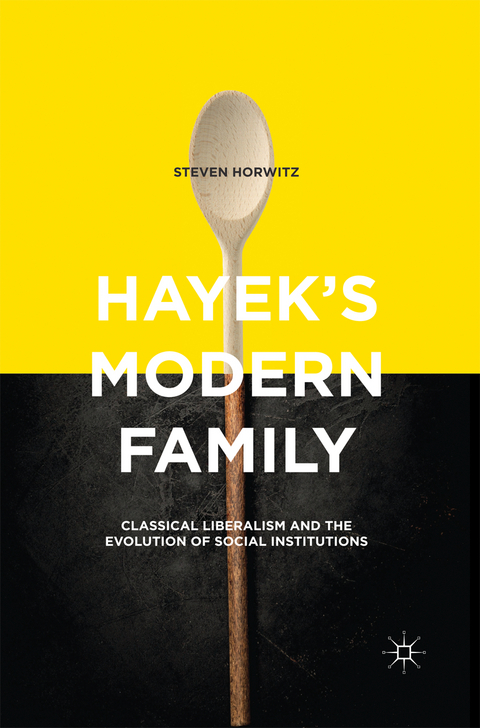
Hayek's Modern Family
Classical Liberalism and the Evolution of Social Institutions
Seiten
2016
|
2015 ed.
Palgrave Macmillan (Verlag)
978-1-349-56247-3 (ISBN)
Palgrave Macmillan (Verlag)
978-1-349-56247-3 (ISBN)
Scholars within the Hayekian-Austrian tradition of classical liberalism have done virtually no work on the family as an economic and social institution. Hayek's Modern Family offers a classical liberal theory of the family, taking Hayekian social theory as the main analytical framework.
Scholars within the Hayekian-Austrian tradition of classical liberalism have done virtually no work on the family as an economic and social institution. In addition, there is a real paucity of scholarship on the place of the family within classical liberal and libertarian political philosophy. Hayek's Modern Family offers a classical liberal theory of the family, taking Hayekian social theory as the main analytical framework. Horwitz argues that families are social institutions that perform certain irreplaceable functions in society. These functions change as economic, political, and social circumstances change, and the family form adapts accordingly, kicking off the next wave of developments in the social structure. In Hayekian terms, the family is an evolving and undesigned social institution. Horwitz offers a non-conservative defense of the family as a social institution against the view that either the state or "the village" is able or required to take over its irreplaceable functions.
Scholars within the Hayekian-Austrian tradition of classical liberalism have done virtually no work on the family as an economic and social institution. In addition, there is a real paucity of scholarship on the place of the family within classical liberal and libertarian political philosophy. Hayek's Modern Family offers a classical liberal theory of the family, taking Hayekian social theory as the main analytical framework. Horwitz argues that families are social institutions that perform certain irreplaceable functions in society. These functions change as economic, political, and social circumstances change, and the family form adapts accordingly, kicking off the next wave of developments in the social structure. In Hayekian terms, the family is an evolving and undesigned social institution. Horwitz offers a non-conservative defense of the family as a social institution against the view that either the state or "the village" is able or required to take over its irreplaceable functions.
Steven Horwitz is Charles A. Dana Professor of Economics at St. Lawrence University, USA, and an Affiliated Senior Scholar at the Mercatus Center at George Mason University, USA. He is the author of two books on monetary economics, and has written extensively on the social thought of F.A. Hayek and the Austrian school of economics.
| Erscheinungsdatum | 15.05.2018 |
|---|---|
| Zusatzinfo | XIII, 313 p. |
| Verlagsort | Basingstoke |
| Sprache | englisch |
| Maße | 155 x 235 mm |
| Themenwelt | Sachbuch/Ratgeber ► Gesundheit / Leben / Psychologie ► Familie / Erziehung |
| Geschichte ► Teilgebiete der Geschichte ► Wirtschaftsgeschichte | |
| Wirtschaft ► Allgemeines / Lexika | |
| Wirtschaft ► Volkswirtschaftslehre ► Wirtschaftspolitik | |
| ISBN-10 | 1-349-56247-5 / 1349562475 |
| ISBN-13 | 978-1-349-56247-3 / 9781349562473 |
| Zustand | Neuware |
| Informationen gemäß Produktsicherheitsverordnung (GPSR) | |
| Haben Sie eine Frage zum Produkt? |
Mehr entdecken
aus dem Bereich


aus dem Bereich
wie Tech-Konzerne und Großmächte die Welt unter sich aufteilen
Buch | Hardcover (2025)
C.H.Beck (Verlag)
CHF 39,20


