


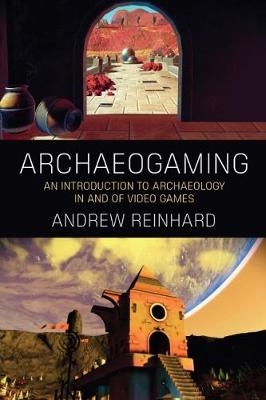
Archaeogaming
An Introduction to Archaeology in and of Video Games
Seiten
2018
Berghahn Books (Verlag)
978-1-78533-873-1 (ISBN)
Berghahn Books (Verlag)
978-1-78533-873-1 (ISBN)
Video games exemplify contemporary material objects, resources, and spaces that people use to define their culture. This book serves as a general introduction to "archaeogaming"; it describes the intersection of archaeology and video games and applies archaeological method and theory into understanding game-spaces as both site and artifact.
A general introduction to archeogaming describing the intersection of archaeology and video games and applying archaeological method and theory into understanding game-spaces.
“[T]he author’s clarity of style makes it accessible to all readers, with or without an archaeological background. Moreover, his personal anecdotes and gameplay experiences with different game titles, from which his ideas often develop, make it very enjoyable reading.”—Antiquity
Video games exemplify contemporary material objects, resources, and spaces that people use to define their culture. Video games also serve as archaeological sites in the traditional sense as a place, in which evidence of past activity is preserved and has been, or may be, investigated using the discipline of archaeology, and which represents a part of the archaeological record.
From the introduction:
Archaeogaming, broadly defined, is the archaeology both in and of digital games… As will be described in the following chapters, digital games are archaeological sites, landscapes, and artifacts, and the game-spaces held within those media can also be understood archaeologically as digital built environments containing their own material culture… Archaeogaming does not limit its study to those video games that are set in the past or that are treated as “historical games,” nor does it focus solely on the exploration and analysis of ruins or of other built environments that appear in the world of the game. Any video game—from Pac-Man to Super Meat Boy—can be studied archaeologically.
A general introduction to archeogaming describing the intersection of archaeology and video games and applying archaeological method and theory into understanding game-spaces.
“[T]he author’s clarity of style makes it accessible to all readers, with or without an archaeological background. Moreover, his personal anecdotes and gameplay experiences with different game titles, from which his ideas often develop, make it very enjoyable reading.”—Antiquity
Video games exemplify contemporary material objects, resources, and spaces that people use to define their culture. Video games also serve as archaeological sites in the traditional sense as a place, in which evidence of past activity is preserved and has been, or may be, investigated using the discipline of archaeology, and which represents a part of the archaeological record.
From the introduction:
Archaeogaming, broadly defined, is the archaeology both in and of digital games… As will be described in the following chapters, digital games are archaeological sites, landscapes, and artifacts, and the game-spaces held within those media can also be understood archaeologically as digital built environments containing their own material culture… Archaeogaming does not limit its study to those video games that are set in the past or that are treated as “historical games,” nor does it focus solely on the exploration and analysis of ruins or of other built environments that appear in the world of the game. Any video game—from Pac-Man to Super Meat Boy—can be studied archaeologically.
Andrew Reinhard is a Cultural Resource Management (CRM) Project Director for Metcalf Archaeological Consultants and is also a Research Affiliate at the Institute for the Study of the Ancient World (ISAW) at New York University. He is editor of the series Digital Archaeology: Documenting the Anthropocene published by Berghahn.
List of Illustrations
Acknowledgements
Introduction
Chapter 1. Real-World Archaeogaming
Chapter 2. Playing as Archaeologists
Chapter 3. Video Games as Archaeological Sites
Chapter 4. Material Culture of the Immaterial
Conclusion
Appendix: No Man’s Sky Archaeological Survey (NMSAS) Code of Ethics
Works Cited
Games Cited
Index
| Erscheinungsdatum | 09.08.2018 |
|---|---|
| Zusatzinfo | Bibliography; Index; 22 Illustrations |
| Verlagsort | Oxford |
| Sprache | englisch |
| Maße | 152 x 229 mm |
| Themenwelt | Geisteswissenschaften ► Archäologie |
| Geschichte ► Allgemeine Geschichte ► Vor- und Frühgeschichte | |
| ISBN-10 | 1-78533-873-0 / 1785338730 |
| ISBN-13 | 978-1-78533-873-1 / 9781785338731 |
| Zustand | Neuware |
| Informationen gemäß Produktsicherheitsverordnung (GPSR) | |
| Haben Sie eine Frage zum Produkt? |
Mehr entdecken
aus dem Bereich



aus dem Bereich
auf den Spuren der frühen Zivilisationen
Buch | Hardcover (2023)
C.H.Beck (Verlag)
CHF 27,95
Erkennen. Bestimmen. Beschreiben
Buch | Softcover (2022)
Deutscher Kunstverlag
CHF 27,85


