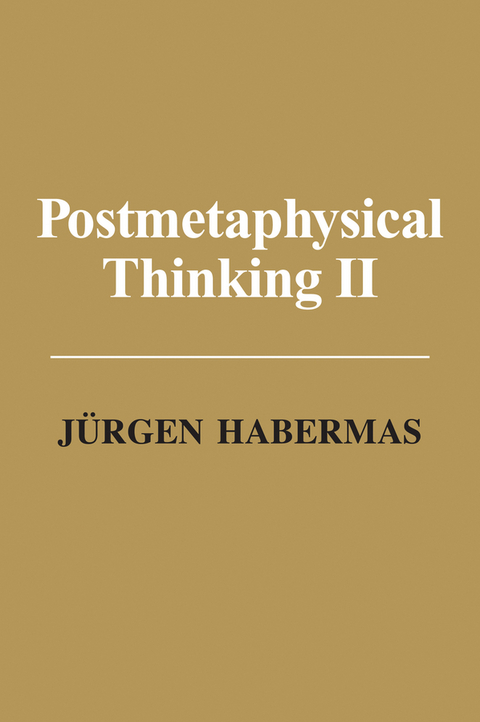
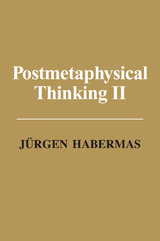
Postmetaphysical Thinking II (eBook)
John Wiley & Sons (Verlag)
978-0-7456-9493-1 (ISBN)
'There is no alternative to postmetaphysical thinking': this statement, made by Jürgen Habermas in 1988, has lost none of its relevance. Postmetaphysical thinking is, in the first place, the historical answer to the crisis of metaphysics following Hegel, when the central metaphysical figures of thought began to totter under the pressure exerted by social developments and by developments within science. As a result, philosophy's epistemological privilege was shaken to its core, its basic concepts were de-transcendentalized, and the primacy of theory over practice was opened to question. For good reasons, philosophy 'lost its extraordinary status', but as a result it also courted new problems. In Postmetaphysical Thinking II, the sequel to the 1988 volume that bears the same title (English translation, Polity 1992), Habermas addresses some of these problems.
The first section of the book deals with the shift in perspective from metaphysical worldviews to the lifeworld, the unarticulated meanings and assumptions that accompany everyday thought and action in the mode of 'background knowledge'. Habermas analyses the lifeworld as a 'space of reasons' - even where language is not (yet) involved, such as, for example, in gestural communication and rituals. In the second section, the uneasy relationship between religion and postmetaphysical thinking takes centre stage. Habermas picks up where he left off in 1988, when he made the far-sighted observation that 'philosophy, even in its postmetaphysical form, will be able neither to replace nor to repress religion', and explores philosophy's new-found interest in religion, among other topics. The final section includes essays on the role of religion in the political context of a post-secular, liberal society.
This volume will be of great interest to students and scholars in philosophy, religion and the social sciences and humanities generally.
Jürgen Habermas is Emeritus Professor of Philosophy at the Johann Wolfgang Goethe University of Frankfurt and one of the most influential social and political thinkers in the world today.
There is no alternative to postmetaphysical thinking : this statement, made by J rgen Habermas in 1988, has lost none of its relevance. Postmetaphysical thinking is, in the first place, the historical answer to the crisis of metaphysics following Hegel, when the central metaphysical figures of thought began to totter under the pressure exerted by social developments and by developments within science. As a result, philosophy s epistemological privilege was shaken to its core, its basic concepts were de-transcendentalized, and the primacy of theory over practice was opened to question. For good reasons, philosophy lost its extraordinary status , but as a result it also courted new problems. In Postmetaphysical Thinking II, the sequel to the 1988 volume that bears the same title (English translation, Polity 1992), Habermas addresses some of these problems. The first section of the book deals with the shift in perspective from metaphysical worldviews to the lifeworld, the unarticulated meanings and assumptions that accompany everyday thought and action in the mode of background knowledge . Habermas analyses the lifeworld as a space of reasons even where language is not (yet) involved, such as, for example, in gestural communication and rituals. In the second section, the uneasy relationship between religion and postmetaphysical thinking takes centre stage. Habermas picks up where he left off in 1988, when he made the far-sighted observation that philosophy, even in its postmetaphysical form, will be able neither to replace nor to repress religion , and explores philosophy s new-found interest in religion, among other topics. The final section includes essays on the role of religion in the political context of a post-secular, liberal society. This volume will be of great interest to students and scholars in philosophy, religion and the social sciences and humanities generally.
Jürgen Habermas is Emeritus Professor of Philosophy at the Johann Wolfgang Goethe University of Frankfurt and one of the most influential social and political thinkers in the world today.
Contents
Linguistification of the Sacred. In Place of a Preface
I The Lifeworld as a Space of Reasons
1. From Worldviews to the Lifeworld
2. The Lifeworld as a Space of Symbolically Embodied Reasons
3. A Hypothesis concerning the Evolutionary Meaning of Rites
II Postmetaphysical Thinking
4. The New Philosophical Interest in Religion. An Conversation with Eduardo Mendieta
5. Religion and Postmetaphysical Thinking: A Reply
6. A Symposium on Faith and Knowledge: Reply to Objections, Response to Suggestions
III Politics and Religion
7. ?The Political?: The Rational Meaning of a Questionable Inheritance of Political Theology
8. The ?Good Life? ? a ?Detestable Phrase?: The Significance of the Young Rawls?s Religious Ethics for His Political Theory
9. Rawls?s Political Liberalism: Reply to the Resumption of a Discussion
10. Religion in the Public Sphere of ?Post-Secular? Society
Sources of the Texts
Notes
Index
"This new volume is a remarkable example of a lifework that is still very much a work in progress. It covers a rich variety of topics, honing in particularly on the meaning of religion in public life."
--Die Zeit
1
FROM WORLDVIEWS TO THE LIFEWORLD
When we reflect theoretically on our understanding of the world and of ourselves, we speak in terms of worldviews [Weltbilder] or Weltanschauungen. While the notion of a ‘Weltanschauung’ has the connotation of the process of comprehending the whole, the concept of a ‘worldview’ places the emphasis more on the result of an interpretation of the world – that is, its theoretical or representational character. Both expressions have the existential significance of something which provides orientation – Weltanschauungen and worldviews give us orientation in our life as a whole. This orientational knowledge must not be confused with scientific knowledge even when it claims to represent a synthesis of currently valid research. This explains the distanced tone of the associated terminology. When ‘worldview’ and ‘Weltanschauung’ are not used merely as pejorative expressions to distinguish philosophy from dubious rivals,1 the preference is to apply them retrospectively to the ‘strong’ traditions of the past. Then we mean first and foremost conceptions which can be traced back in one way or another to the cosmological and theocentric worldviews of the Axial Age, also including essential parts of Greek philosophy.
Even today philosophical doctrines still fulfil the function of worldviews to the extent that they have preserved their reference to the world as a whole, to the cosmos, to world history and the history of salvation [Heilsgeschichte], and to a process of natural evolution that includes human beings and culture.2 Such doctrines can be justified as forms of ethical self-interpretation; but the more or less explicit self-interpretation of a particular ethos cannot claim universal validity any longer under modern conditions of the pluralism of worldviews. Moreover, philosophy in the guise of postmetaphysical thinking would also be well advised to refrain from merely producing worldviews. How can it satisfy this requirement without at the same time sacrificing its reference to the whole? Today philosophy as a discipline is disintegrating into the fragments of its hyphenated philosophies by specializing in reconstructing particular competences, such as speaking, acting and knowing, or by reflecting on the pre-existing cultural forms of science, morality, law, religion or art. Can these fragments be reassembled to form a whole by taking the focus on the lifeworld as our starting point? The path leading from worldviews to the concept of the lifeworld which I will sketch here suggests that we can arrive at a non-foundational ‘non-hyphenated’ philosophy after all.
Admittedly, the world of the lifeworld is a different one from that of worldviews. It neither signifies the sublime cosmos or an exemplary order of things, nor does it refer to a fateful saeculum or an eon – that is, to an ordered succession of occurrences of relevance for salvation. The lifeworld does not confront us as a theoretical object; rather, we find ourselves in the lifeworld in a pre-theoretical sense. It encompasses and supports us insofar as we, as finite beings, cope with the things and events we encounter in the world. Husserl speaks of the ‘horizon’ of the lifeworld and of its ‘function as a ground’ for our everyday activities. To anticipate, the lifeworld can be described as the insurmountable, only intuitively accompanying horizon of experience and as the uncircumventable, non-objectively present experiential background of a personal, historically situated, embodied and communicatively socialized everyday existence. We become aware of this mode of existence under a variety of aspects. We become aware of ourselves performatively as experiencing subjects who are embedded in organic life processes, as socialized persons who are enmeshed in their social relations and practices, and as actors who intervene in the world. What is compressed into this compact formula cannot be contemplated like the starry heavens above us; and it is not something that can be accepted as binding truth trusting in the word of God.
When we engage in explicit communication about something in the world, we are operating in a milieu that has always been constructed on the basis of such performative certainties. It is the task of philosophical reflection to bring the most general features – as it were, the architectonic – of the lifeworld to consciousness. Therefore, this philosophical description refers not to how the world in itself hangs together but to the conditions of our access to what takes place in the world. All that is left of the image of the world after this anthropocentric return to the ground and horizon of our beingin-the-world is the empty framework for possible factual knowledge.
With this, the analysis of the lifeworld background also loses the orienting function of worldviews, which with their theoretical access to the whole also promise to provide practical insight into how to lead our lives. Husserl nevertheless wants to extract an important practical lesson from the phenomenology of the lifeworld, which he conceives as a strictly descriptive enterprise. Specifically, with this concept he wants to uncover the forgotten ‘meaning foundation’ of science and thus to preserve knowledge-based society from the far-reaching consequences of objectivism. Today the challenge posed by an excessively scientistic form of naturalism raises a similar question – namely, whether and, if necessary, in what sense the epistemic role of the lifeworld sets limits to a scientific revision of how people understand themselves in their everyday lives.
I would like to test the plausibility of Husserl’s thesis of the forgotten meaning foundation in terms of a rough outline of the development of worldviews. With the spread of an ontological world concept and, later, the construction of an epistemological concept of world,3 European philosophy on the one hand played a central role in the cognitive process of disentangling the objective world of science from the projective objectivization of aspects of lifeworlds which operate in the background. As a secular intellectual formation, philosophy turned its back on religion while simultaneously renouncing strong metaphysical claims to knowledge. On the other hand, while it contributed to the genealogy of a disenchanted and objectivized concept of the empirical world, philosophy suppressed the epistemic role of the lifeworld. Therefore, I am interested in how reflection on this repressed background changes the self-understanding of postmetaphysical thinking.
Anticipating the communicative concept of the lifeworld, I will first explain the difference between ‘lifeworld’, ‘objective world’ and ‘everyday world’ (1). These basic concepts will serve to relate the critique of science to the context of worldview development. The interesting thing about this development is the progressive cognitive liberation of the ‘objective world’ from projections of the ‘lifeworld’ (2) and how the resulting problems of the objectivized image of the world of natural science are dealt with by transcendental philosophy (3). This picture is further complicated by the rise of human and social science, which at the same time represent a challenge for transcendental philosophy (4). The bipolar objectivization of our picture of the objective world and a corresponding detranscendentalization of the underlying constituting subjectivity explain why Husserl’s critique of science becomes heightened into a dilemma. The complementarity between the lifeworld and the objective world, which we cannot circumvent in actu, is connected with a form of epistemic dualism which conflicts with the need for a monistic interpretation of the world (5). In conclusion, I will briefly examine some attempts to find a way out of this dilemma (6).
(1) The concept of the lifeworld is based on the distinction between performative consciousness and fallible knowledge. The unique character of the attendant, intuitively certain background knowledge that accompanies us in our everyday routines but always remains implicit can be explained by the fact that the lifeworld is present to us only in a performative manner, when we perform actions which are always directed to something else. The fear of losing one’s foothold on loose gravel or the feeling of blushing over an embarrassing mistake, the sudden realization that one can no longer count on the loyalty of an old friend, or what it means for a long cherished background assumption suddenly to begin to totter – these are all things that we ‘know’. For in situations such as these in which established routines are disrupted, a layer of implicit knowledge is uncovered, be it a habitual ability, a sensitivity, a dependable social relationship or a firm conviction. As long as they remain unthematized in the background, these components of the performative knowledge thus adumbrated form an amalgam.
In principle each of these certainties can be transformed from a resource of social cooperation and communication into a theme, especially when the normal routine is disrupted and dissonances arise. Hence, the lifeworld described in phenomenological terms can also be understood as the background of communicative action and be related to processes of reaching understanding.4 Then it is no longer the conscious life of a transcendental ego...
| Erscheint lt. Verlag | 16.6.2017 |
|---|---|
| Übersetzer | Ciaran Cronin |
| Sprache | englisch |
| Themenwelt | Geisteswissenschaften ► Philosophie ► Allgemeines / Lexika |
| Geisteswissenschaften ► Philosophie ► Geschichte der Philosophie | |
| Geisteswissenschaften ► Philosophie ► Metaphysik / Ontologie | |
| Geisteswissenschaften ► Philosophie ► Philosophie der Neuzeit | |
| Schlagworte | Philosophie • Philosophie in den Naturwissenschaften • Philosophy • Philosophy of Religion • philosophy of religion, philosophy of science, Hegel • philosophy of science • Religionsphilosophie • Social Philosophy • Sozialphilosophie |
| ISBN-10 | 0-7456-9493-4 / 0745694934 |
| ISBN-13 | 978-0-7456-9493-1 / 9780745694931 |
| Informationen gemäß Produktsicherheitsverordnung (GPSR) | |
| Haben Sie eine Frage zum Produkt? |
 EPUB (Adobe DRM)
Kopierschutz: Adobe-DRM
Adobe-DRM ist ein Kopierschutz, der das eBook vor Mißbrauch schützen soll. Dabei wird das eBook bereits beim Download auf Ihre persönliche Adobe-ID autorisiert. Lesen können Sie das eBook dann nur auf den Geräten, welche ebenfalls auf Ihre Adobe-ID registriert sind.
Details zum Adobe-DRM
Dateiformat: EPUB (Electronic Publication)
EPUB ist ein offener Standard für eBooks und eignet sich besonders zur Darstellung von Belletristik und Sachbüchern. Der Fließtext wird dynamisch an die Display- und Schriftgröße angepasst. Auch für mobile Lesegeräte ist EPUB daher gut geeignet.
Systemvoraussetzungen:
PC/Mac: Mit einem PC oder Mac können Sie dieses eBook lesen. Sie benötigen eine
eReader: Dieses eBook kann mit (fast) allen eBook-Readern gelesen werden. Mit dem amazon-Kindle ist es aber nicht kompatibel.
Smartphone/Tablet: Egal ob Apple oder Android, dieses eBook können Sie lesen. Sie benötigen eine
Geräteliste und zusätzliche Hinweise
Buying eBooks from abroad
For tax law reasons we can sell eBooks just within Germany and Switzerland. Regrettably we cannot fulfill eBook-orders from other countries.
aus dem Bereich