Empire of Conspiracy (eBook)
256 Seiten
Cornell University Press (Verlag)
978-1-5017-1301-9 (ISBN)
Timothy Melley is Professor of English, Affiliate of American Studies,and Director of the Humanities Center at Miami University in Oxford, Ohio. He is the author of Empire of Conspiracy: The Culture of Paranoia in Postwar America and The Covert Sphere: Secrecy, Fiction, and the National Security State, both from Cornell.
'Melley identifies an emerging irony that a 'supposedly individualist culture conserves its individualism by continually imagining it to be in imminent peril.'. . . Melley's commentary on the new significance of the corporation in the postwar period makes up one of the most interesting sections of his study. . . Empire of Conspiracy makes an important contribution to the current re-examination of Cold War culture, especially to the debate over human agency.'-David Seed, Liverpool University. Journal of American Studies, 36 (2002), 2.
'The myth of 'individualism' rests as clearly fixed in Melley's sights as the Kennedy limo was in Oswald's. . . .Melley highlights the power and significance of 'Gravity's Rainbow' in its historical moment. . . .In demonstrating how extensively 'Gravity's Rainbow' chronicles the dissolution of human bodies in the corpus of information, and in connecting this dissolution to postwar agency panic, Melley is also restoring to the novel a much needed sense of its historicity. . . ..What should I make. . . of the fact that when I was halfway through the writing of this essay, I received a second copy of 'Empire of Conspiracy' sent to me ostensibly out of the blue, by Melley himself? What did Melley know, and when did he know it?'-Alan Nadel, Rensselaer Polytechnic Institute. Contemporary Literature XLIII, 2, Summer 2002
'In Empire of Conspiracy: The Culture of Paranoia in Postwar America, though, Timothy Melley asks good questions. Deftly bringing together concerns about subjectivity and social control that proliferated in the 1950s and that have continued through to the present, Melley surveys diverse manifestations of this phenomenon. . . . Blending insightful literary analysis with skillful theoretical reflection, Empire of Conspiracy is both an important contribution to American studies and an enjoyable read.'-Robert Holton, Carleton University, Psychon Notes
ext>'Empire of Conspiracy has much to offer its readers. The topic is central to contemporary fiction. Timothy Melley writes with truly admirable lucidity. He supplies theoretical background when it is useful, but retains his focus on literature. This is an extremely teachable book that opens many discussions and gives a useful entry into what may be meant by postmodernism.'-Kathryn Hume, Distinguished Professor of English, Pennsylvania State University
'Empire of Conspiracy has much to offer its readers. The topic is central to contemporary fiction. Timothy Melley writes with truly admirable lucidity. He supplies theoretical background when it is useful, but retains his focus on literature. This is an extremely teachable book that opens many discussions and gives a useful entry into what may be meant by postmodernism.'-Kathryn Hume, Distinguished Professor of English, Pennsylvania State University
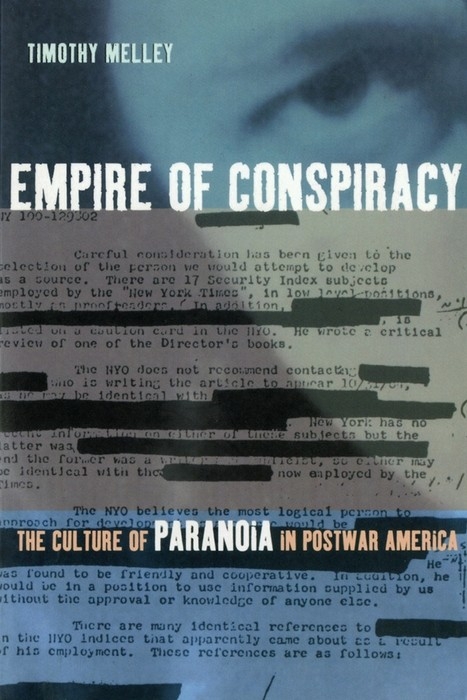
Why, Timothy Melley asks, have paranoia and conspiracy theory become such prominent features of postwar American culture? In Empire of Conspiracy, Melley explores the recent growth of anxieties about thought-control, assassination, political indoctrination, stalking, surveillance, and corporate and government plots. At the heart of these developments, he believes, lies a widespread sense of crisis in the way Americans think about human autonomy and individuality. Nothing reveals this crisis more than the remarkably consistent form of expression that Melley calls agency panic-an intense fear that individuals can be shaped or controlled by powerful external forces. Drawing on a broad range of forms that manifest this fear-including fiction, film, television, sociology, political writing, self-help literature, and cultural theory-Melley provides a new understanding of the relation between postwar American literature, popular culture, and cultural theory.Empire of Conspiracy offers insightful new readings of texts ranging from Joseph Heller's Catch-22 to the Unabomber Manifesto, from Vance Packard's Hidden Persuaders to recent addiction discourse, and from the stalker novels of Margaret Atwood and Diane Johnson to the conspiracy fictions of Thomas Pynchon, William Burroughs, Don DeLillo, and Kathy Acker. Throughout, Melley finds recurrent anxieties about the power of large organizations to control human beings. These fears, he contends, indicate the continuing appeal of a form of individualism that is no longer wholly accurate or useful, but that still underpins a national fantasy of freedom from social control.
| Erscheint lt. Verlag | 1.12.2016 |
|---|---|
| Sprache | englisch |
| Themenwelt | Geisteswissenschaften ► Sprach- / Literaturwissenschaft ► Literaturwissenschaft |
| Sozialwissenschaften ► Ethnologie | |
| Sozialwissenschaften ► Soziologie ► Allgemeines / Lexika | |
| ISBN-10 | 1-5017-1301-9 / 1501713019 |
| ISBN-13 | 978-1-5017-1301-9 / 9781501713019 |
| Informationen gemäß Produktsicherheitsverordnung (GPSR) | |
| Haben Sie eine Frage zum Produkt? |
 PDF (Adobe DRM)
Kopierschutz: Adobe-DRM
Adobe-DRM ist ein Kopierschutz, der das eBook vor Mißbrauch schützen soll. Dabei wird das eBook bereits beim Download auf Ihre persönliche Adobe-ID autorisiert. Lesen können Sie das eBook dann nur auf den Geräten, welche ebenfalls auf Ihre Adobe-ID registriert sind.
Details zum Adobe-DRM
Dateiformat: PDF (Portable Document Format)
Mit einem festen Seitenlayout eignet sich die PDF besonders für Fachbücher mit Spalten, Tabellen und Abbildungen. Eine PDF kann auf fast allen Geräten angezeigt werden, ist aber für kleine Displays (Smartphone, eReader) nur eingeschränkt geeignet.
Systemvoraussetzungen:
PC/Mac: Mit einem PC oder Mac können Sie dieses eBook lesen. Sie benötigen eine
eReader: Dieses eBook kann mit (fast) allen eBook-Readern gelesen werden. Mit dem amazon-Kindle ist es aber nicht kompatibel.
Smartphone/Tablet: Egal ob Apple oder Android, dieses eBook können Sie lesen. Sie benötigen eine
Geräteliste und zusätzliche Hinweise
Buying eBooks from abroad
For tax law reasons we can sell eBooks just within Germany and Switzerland. Regrettably we cannot fulfill eBook-orders from other countries.
aus dem Bereich