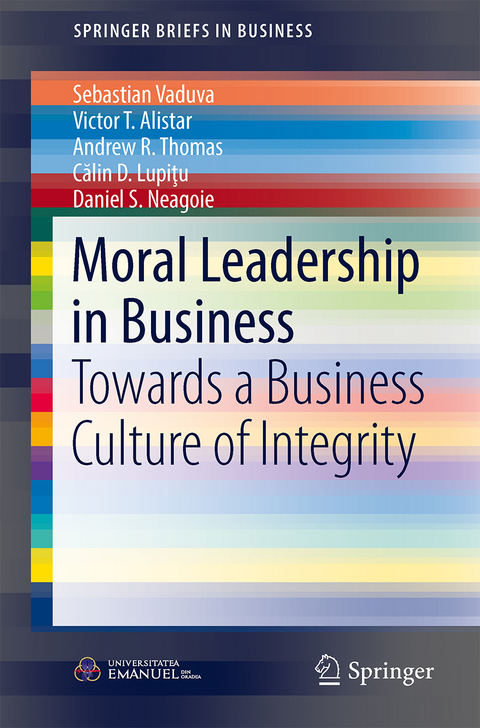
Moral Leadership in Business (eBook)
VIII, 94 Seiten
Springer International Publishing (Verlag)
978-3-319-42881-9 (ISBN)
In the current global economy, we have never before been more tightly-knit and never before has it been easier to distribute goods as well as ideologies. However, in the global marketplace we are only as good as our word, or our reputation, proves to be. Integrity studies by Transparency International show a correlation between corruption and national threat and lists corruption among the most harmful factors to impact local and regional economies. Therefore, successful businesses cannot afford to simply remain materially successful; they have to consider their community impact and become moral leaders before they can be world leaders in their respective field.
Featuring innovative tools, recommendations, case studies and checklists, this brief will be of interest to students, academics, scholars, practitioners and policymakers alike in the fields of leadership, corporate governance, business ethics and corporate social responsibility.
Dr. Sebastian A. Văduva is the current Dean of the Griffiths School of Management at the Emanuel University in Oradea, Romania, as well as a management scholar with numerous active ties, academic and entrepreneurial, in both Europe and the United States. He has developed various seminars on leadership and effective management on both micro- and macro-economic levels and is behind several programs intended to boost Romanian economy by drawing in international investors and business partners.
Dr. Victor T. Alistar is the CEO of Transparency International Romania, with a PhD in Law and Administration from the SNSPA (National School for Political and Administrative Studies) in Bucharest, Romania, where he also teaches. He has extensive experience in media communications and coordinating NGO projects, having also served as a ministerial delegate advising the Romanian Prime-Minister on governmental strategies, transparency and liaising with the civil society.
Dr. Andrew R. Thomas has conducted business in 120 countries on seven continents. A New York Times bestselling author, his books include Aviation Security Management: A Three-Volume Set, Air Rage: Crisis in the Skies and Aviation Insecurity: The New Challenges of Air Travel. He is founding Editor-in-Chief of the Journal of Transportation Security. Often featured on Fox News, MSNBC, CNN, ABC, and other media outlets, he lectures on supply chain security issues around the world.
Dr. Sebastian A. Văduva is the current Dean of the Griffiths School of Management at the Emanuel University in Oradea, Romania, as well as a management scholar with numerous active ties, academic and entrepreneurial, in both Europe and the United States. He has developed various seminars on leadership and effective management on both micro- and macro-economic levels and is behind several programs intended to boost Romanian economy by drawing in international investors and business partners.Dr. Victor T. Alistar is the CEO of Transparency International Romania, with a PhD in Law and Administration from the SNSPA (National School for Political and Administrative Studies) in Bucharest, Romania, where he also teaches. He has extensive experience in media communications and coordinating NGO projects, having also served as a ministerial delegate advising the Romanian Prime-Minister on governmental strategies, transparency and liaising with the civil society. Dr. Andrew R. Thomas has conducted business in 120 countries on seven continents. A New York Times bestselling author, his books include Aviation Security Management: A Three-Volume Set, Air Rage: Crisis in the Skies and Aviation Insecurity: The New Challenges of Air Travel. He is founding Editor-in-Chief of the Journal of Transportation Security. Often featured on Fox News, MSNBC, CNN, ABC, and other media outlets, he lectures on supply chain security issues around the world.Dr. Călin D. Lupiţu is a comparative literature and cultural studies scholar educated in Germany and the UK, with extensive practical training also as a translator and linguist. He teaches language and communication seminars at the Emanuel University of Oradea, where he is also enrolled in the Master’s program in Entrepreneurial Management (MBA).Daniel S. Neagoie is a Romanian consultant in both marketing and academic research and has a master degree in entrepreneurial management. Interested in the field of personal development, research and statistics, Daniel S. Neagoie gives lectures on the topics of organizational behavior, marketing research and management at Griffiths School of Management (Emanuel University of Oradea).
Contents 6
Chapter 1: Moral Leadership 10
1.1 Moral Leadership: From Personal Opinion to Market Recognition 10
1.2 The Three Ingredients of Moral Leadership 11
1.2.1 The Integrated Model of the Functioning of the Three Ingredients 12
1.3 Ethics, Morality, Integrity, and Compliance 13
1.4 Moral Leadership and Profit 14
1.4.1 Low Transactional Costs 14
1.4.2 Lower Promoting Costs 15
1.4.3 Long-Term Profit 15
1.5 The Principles of Moral Leadership 15
1.5.1 Ensure Functional Compliance Settings and Make the Step from Conformism to a Culture of Integrity 16
1.5.2 The Commitment to Transparency Is a Reputation Growth Instrument, Not Just a Cost 16
1.5.3 Involve Your Stakeholders! 17
1.5.4 Reduce the Risks of Lack of Integrity in Creative and Ethical Ways! 18
1.5.5 Communicate Your Business Integrity Model Internally and Externally 18
1.5.6 Develop an Initiative of Promoting Integrity in Your Industry and Determine Other Companies and NGOs to Join You in Promoting Integrity! 19
1.6 Moral Leaders’ Club 19
Chapter 2: From Conformism to a Culture of Integrity 21
2.1 The Compliance Framework: Essential Requirement 21
2.2 The Compliance Processes 22
2.2.1 External Processes: The External Compliance Processes Are Those That Encompass the National and International Compliance Framework as well as the Best-Practices Standards Developed by Certain Industries or Professional Associations 22
2.2.2 Internal Processes: The Internal Compliance Processes Are Those Which Encompass Internal Mechanisms Developed by the Company in Order to Ensure Application of External Standards in Agreement with the Particularities and Needs of the Company, Thu 23
2.3 Compliance Principles 23
2.4 Legal Conformism 24
2.5 Moving from Conformism to a Culture of Integrity 25
2.6 Ethics, Integrity, and the Fight Against Corruption 26
2.7 The Main Instruments that Ensure Evolving from Legal Conformism to a Culture of Integrity 28
2.7.1 The Mission Statement 28
2.7.2 The Code of Conduct 28
2.7.3 The Ethics Training 29
2.7.4 The Anti-bribery Program 29
2.7.5 Policies for Preventing Conflicts of Interest 29
2.7.6 Integrity Awareness Policies 30
2.7.7 Developing Internal Warning Systems 30
2.7.8 Developing Informing and Awareness Mechanisms Regarding the Existence of Policies Regarding Integrity Awareness Among Employees 30
2.7.9 Developing Protection Mechanisms Against Consequences 31
Chapter 3: Corporate Transparency 32
3.1 Trends and Landmarks Regarding Corporate Transparency 33
3.2 The Benefits of Corporate Transparency 36
3.3 Challenges Raised by Corporate Transparency 37
3.4 How to Counteract Fears and Win 38
3.5 Essential Requirement for Effective Transparency: The Information Provided by the Company Are Relevant and Pertinent for Its Stakeholders 40
3.6 Transparency Regarding the Efforts of Influencing the Public’s Decision 41
3.7 Social Dialogue 42
3.8 Lobby Versus Advocacy 43
3.9 Models and Current Lobby Regulations 44
3.10 About Lobbying with Distrust 45
3.11 Transparency: The Key to Rehabilitating the Notion of Lobby 47
3.12 Recommendations for Excellence 50
Chapter 4: Stakeholders’ Management 52
4.1 Who Are, in Fact, the Stakeholders? 53
4.2 Stakeholders’ Management Theory 54
4.3 From Stakeholders’ Management to Stakeholders’ Involvement 56
4.4 Transparency and Accountability for the Commitments Toward Stakeholders 57
4.5 The Benefits of Stakeholders’ Management 58
4.5.1 Advantages of Engaging Stakeholders 62
4.6 How Do We Build a Mutually Profitable Partnership with the Stakeholders? 64
4.6.1 Steps Toward Efficient Stakeholders’ Management 64
4.6.2 Mapping Stakeholders 67
4.6.3 Steps to Follow for an Efficient Engagement of the Stakeholders 70
4.6.4 Steps to Follow in the Decision-Making Process 70
4.7 Recommendations for Excellence 75
4.7.1 Practical Recommendations for Increasing a Company’s Capacity in Having a Performing Stakeholders’ Management 75
4.7.2 Recommendations in Order to Ensure Real Transparency Vis-à-vis the Stakeholders 77
4.7.3 The Management of Sensitive Information in Relation to the Stakeholders 79
4.7.4 Recommendations for the Main Actors in the Business Environment in Order to Ensure an Efficient Stakeholders’ Management 81
Chapter 5: Management of Risks 83
5.1 Reputational Risks 84
5.1.1 The Benefits of a Good Reputation 85
5.1.2 The Consequences of a Bad Reputation 86
5.2 The Principles of the Management of Risks 86
5.2.1 The Principles of Risk Management, According to the ISO 31000 Standards 86
5.3 The Management of Dishonesty Risks 87
5.3.1 Identifying the Risks 91
5.3.2 Identifying the Risks 92
5.4 Implications of Risk Management 95
5.4.1 The Benefits of Evaluating the Integrity Risks 95
5.5 Recommendations for Excellence 97
5.5.1 Practical Recommendations for Reducing the Dishonesty Risk 97
5.5.2 Recommendations Regarding Risk Management for the Main Actors Involved in the Business Environment 98
Chapter 6: Instead of Conclusions 99
6.1 Monitoring and Evaluating Integrity Mechanisms’ Impact 99
6.2 Checklist for Evaluating the Integrity of Your Business 100
| Erscheint lt. Verlag | 14.9.2016 |
|---|---|
| Reihe/Serie | SpringerBriefs in Business | SpringerBriefs in Business |
| Zusatzinfo | VIII, 94 p. 22 illus. in color. |
| Verlagsort | Cham |
| Sprache | englisch |
| Themenwelt | Geisteswissenschaften ► Philosophie ► Allgemeines / Lexika |
| Geisteswissenschaften ► Philosophie ► Ethik | |
| Wirtschaft ► Betriebswirtschaft / Management ► Unternehmensführung / Management | |
| Schlagworte | Business Ethics • Corporate Social Responsibility • Corporate Social Responsibility (CSR) • Corporate Transparency • Culture of Integrity • Moral Leadership • Reputation • Risk Management |
| ISBN-10 | 3-319-42881-0 / 3319428810 |
| ISBN-13 | 978-3-319-42881-9 / 9783319428819 |
| Informationen gemäß Produktsicherheitsverordnung (GPSR) | |
| Haben Sie eine Frage zum Produkt? |
 PDF (Wasserzeichen)
DRM: Digitales Wasserzeichen
Dieses eBook enthält ein digitales Wasserzeichen und ist damit für Sie personalisiert. Bei einer missbräuchlichen Weitergabe des eBooks an Dritte ist eine Rückverfolgung an die Quelle möglich.
Dateiformat: PDF (Portable Document Format)
Mit einem festen Seitenlayout eignet sich die PDF besonders für Fachbücher mit Spalten, Tabellen und Abbildungen. Eine PDF kann auf fast allen Geräten angezeigt werden, ist aber für kleine Displays (Smartphone, eReader) nur eingeschränkt geeignet.
Systemvoraussetzungen:
PC/Mac: Mit einem PC oder Mac können Sie dieses eBook lesen. Sie benötigen dafür einen PDF-Viewer - z.B. den Adobe Reader oder Adobe Digital Editions.
eReader: Dieses eBook kann mit (fast) allen eBook-Readern gelesen werden. Mit dem amazon-Kindle ist es aber nicht kompatibel.
Smartphone/Tablet: Egal ob Apple oder Android, dieses eBook können Sie lesen. Sie benötigen dafür einen PDF-Viewer - z.B. die kostenlose Adobe Digital Editions-App.
Buying eBooks from abroad
For tax law reasons we can sell eBooks just within Germany and Switzerland. Regrettably we cannot fulfill eBook-orders from other countries.
aus dem Bereich