


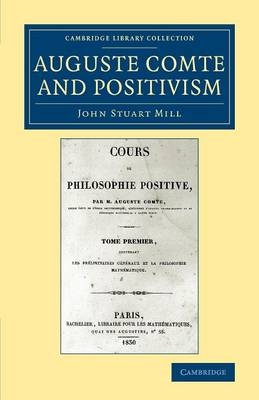
Auguste Comte and Positivism
Seiten
2016
Cambridge University Press (Verlag)
978-1-108-07991-4 (ISBN)
Cambridge University Press (Verlag)
978-1-108-07991-4 (ISBN)
Reissued in its revised 1866 second edition, this is Mill's discussion of the positivist views of French philosopher and social scientist Auguste Comte (1798-1857). Mill analyses Comte's earlier works on positivism in the natural and social sciences, and then positivism's application in areas such as religion and ethics.
Reissued in its revised 1866 second edition, this work by John Stuart Mill (1806-73) discusses the positivist views of the French philosopher and social scientist Auguste Comte (1798-1857). Comte is regarded as the founder of positivism, the doctrine that all knowledge must derive from sensory experience. The two-part text was originally printed as two articles in the Westminster Review in 1865. Part 1 offers an analysis of Comte's earlier works on positivism in the natural and social sciences, while Part 2 considers its application in areas such as religion and ethics. Mill states that Comte is the first philosopher who has attempted to extend positivism 'to all objects of human knowledge'. Despite being critical of a number of Comte's views, such as the exclusion of psychology from positivist science, Mill acknowledges his fellow philosopher's influence in the face of common negative perceptions of the positivist movement.
Reissued in its revised 1866 second edition, this work by John Stuart Mill (1806-73) discusses the positivist views of the French philosopher and social scientist Auguste Comte (1798-1857). Comte is regarded as the founder of positivism, the doctrine that all knowledge must derive from sensory experience. The two-part text was originally printed as two articles in the Westminster Review in 1865. Part 1 offers an analysis of Comte's earlier works on positivism in the natural and social sciences, while Part 2 considers its application in areas such as religion and ethics. Mill states that Comte is the first philosopher who has attempted to extend positivism 'to all objects of human knowledge'. Despite being critical of a number of Comte's views, such as the exclusion of psychology from positivist science, Mill acknowledges his fellow philosopher's influence in the face of common negative perceptions of the positivist movement.
1. The cours de philosophie positive; 2. The later speculations of M. Comte.
| Erscheint lt. Verlag | 28.7.2016 |
|---|---|
| Reihe/Serie | Cambridge Library Collection - Philosophy |
| Zusatzinfo | Worked examples or Exercises |
| Verlagsort | Cambridge |
| Sprache | englisch |
| Maße | 140 x 218 mm |
| Gewicht | 290 g |
| Themenwelt | Geisteswissenschaften ► Philosophie ► Geschichte der Philosophie |
| Geisteswissenschaften ► Philosophie ► Philosophie der Neuzeit | |
| ISBN-10 | 1-108-07991-1 / 1108079911 |
| ISBN-13 | 978-1-108-07991-4 / 9781108079914 |
| Zustand | Neuware |
| Informationen gemäß Produktsicherheitsverordnung (GPSR) | |
| Haben Sie eine Frage zum Produkt? |
Mehr entdecken
aus dem Bereich



aus dem Bereich
eine Geschichte der Zuversicht von Homer bis zum Klimawandel
Buch | Hardcover (2024)
C.H.Beck (Verlag)
CHF 39,20
die kolonialen Wurzeln der französischen Theorie
Buch | Hardcover (2024)
Matthes & Seitz Berlin (Verlag)
CHF 41,90


