


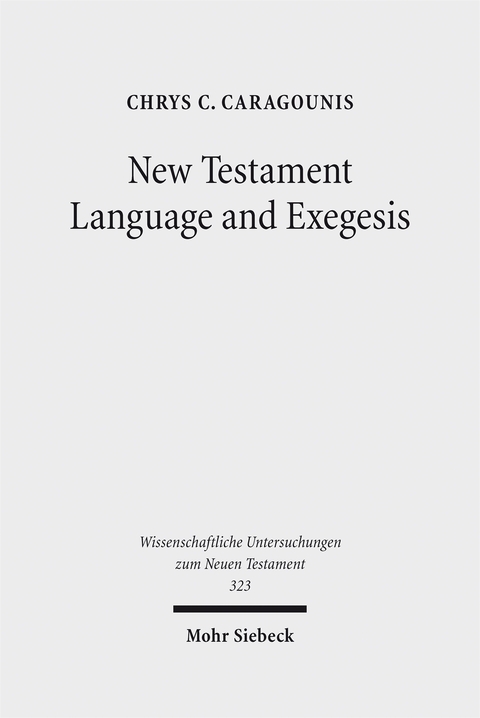
New Testament Language and Exegesis
A Diachronic Approach
Seiten
Chrys C. Caragounis untersucht die Sprache des Neuen Testaments unter dem Aspekt der historischen Entwicklung, in der sich das klassische Griechisch zum "hellenistischen", dann zum byzantinischen und zuletzt neohellenischen wandelte. Das erklärt die Eigenheiten und Auffälligkeiten des neutestamentlichen Griechisch und zeigt, dass diese Teil eines weit größeren Prozesses der Modernisierung der Sprache waren.
A sequel as well as an advance on the author's study The Development of Greek and the New Testament (WUNT 167), Chrys C. Caragounis applies the diachronic or holistic approach to the exegesis of the New Testament in this volume. He takes up for discussion a number of grammatico-syntactical areas of the New Testament and shows that previous exegesis, misguided by a myopic view of and approach to the Greek language, has not infrequently played havoc with the meaning and interpretation of its text. He studies the language of the New Testament in the light of historical developments that changed Greek from classical to 'Hellenistic', then to Byzantine, and finally to Neohellenic. These explain the oddities or peculiarities of the New Testament Greek, showing them to be a part of a much larger process at modernizing the language. By drawing upon the whole linguistic evidence available, the reader is led to a more genuine, more correct understanding of the New Testament text.
A sequel as well as an advance on the author's study The Development of Greek and the New Testament (WUNT 167), Chrys C. Caragounis applies the diachronic or holistic approach to the exegesis of the New Testament in this volume. He takes up for discussion a number of grammatico-syntactical areas of the New Testament and shows that previous exegesis, misguided by a myopic view of and approach to the Greek language, has not infrequently played havoc with the meaning and interpretation of its text. He studies the language of the New Testament in the light of historical developments that changed Greek from classical to 'Hellenistic', then to Byzantine, and finally to Neohellenic. These explain the oddities or peculiarities of the New Testament Greek, showing them to be a part of a much larger process at modernizing the language. By drawing upon the whole linguistic evidence available, the reader is led to a more genuine, more correct understanding of the New Testament text.
Born 1940; Professor Emeritus in New Testament Exegesis at Lund University, Sweden.
| Erscheint lt. Verlag | 30.1.2014 |
|---|---|
| Reihe/Serie | Wissenschaftliche Untersuchungen zum Neuen Testament |
| Verlagsort | Tübingen |
| Sprache | englisch |
| Maße | 163 x 238 mm |
| Gewicht | 810 g |
| Themenwelt | Religion / Theologie ► Christentum ► Bibelausgaben / Bibelkommentare |
| Schlagworte | Approach • Aspects • Greek • Historical • Historical Approach to Greek • Interpretation • Interpretation of the New Testament • Linguistics • Neues Testament • New • of • Rhetorical • Rhetorical Aspects of the New Testament • Testament • the • to |
| ISBN-10 | 3-16-152764-X / 316152764X |
| ISBN-13 | 978-3-16-152764-7 / 9783161527647 |
| Zustand | Neuware |
| Informationen gemäß Produktsicherheitsverordnung (GPSR) | |
| Haben Sie eine Frage zum Produkt? |
Mehr entdecken
aus dem Bereich


aus dem Bereich
Buch | Softcover (2021)
De Gruyter (Verlag)
CHF 44,90
die Weihnachtsbotschaft – entstaubt, durchgelüftet, neuentdeckt
Buch | Hardcover (2024)
Verlag Herder
CHF 28,90


