


Reading the Sealed Book
Old Greek Isaiah and the Problem of Septuagint Hermeneutics
Seiten
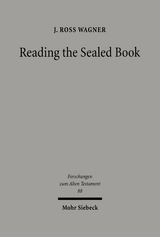
How can interpretative elements be identified in a translated text? J. Ross Wagner develops an interpretive approach to the Septuagint combining patient investigation of the process of translation with careful attention to the rhetorical shape of the translated text and displays the fruitfulness of this method through a close reading of the Old Greek version of Isaiah's opening vision.
Interest in the Septuagint has never been greater, with major translation and commentary projects completed or well underway in German, French, English, and Spanish. Dating from the 3rd century BCE to the 1st century CE, these translations open a window onto early Jewish interpretation of the Bible. Yet crucial problems of "Septuagint hermeneutics," particularly the question of how to identify interpretive elements in a translated text, remain unresolved. Drawing on important work both in translation studies and in literary theory, J. Ross Wagner develops an interpretive approach that combines patient investigation of the process of translation with careful attention to the rhetorical shape of the translated text. The author demonstrates the fruitfulness of this method through a close reading of Isaiah s opening vision (Isa 1:1-31) as both translation and text.
Published in North America by Baylor University Press, Waco.
Interest in the Septuagint has never been greater, with major translation and commentary projects completed or well underway in German, French, English, and Spanish. Dating from the 3rd century BCE to the 1st century CE, these translations open a window onto early Jewish interpretation of the Bible. Yet crucial problems of "Septuagint hermeneutics," particularly the question of how to identify interpretive elements in a translated text, remain unresolved. Drawing on important work both in translation studies and in literary theory, J. Ross Wagner develops an interpretive approach that combines patient investigation of the process of translation with careful attention to the rhetorical shape of the translated text. The author demonstrates the fruitfulness of this method through a close reading of Isaiah s opening vision (Isa 1:1-31) as both translation and text.
Published in North America by Baylor University Press, Waco.
Born 1966; 1998 PhD from Duke University; since 2013 Associate Professor of New Testament at Duke University.
| Erscheint lt. Verlag | 22.10.2013 |
|---|---|
| Reihe/Serie | Forschungen zum Alten Testament |
| Verlagsort | Tübingen |
| Sprache | englisch |
| Maße | 163 x 241 mm |
| Gewicht | 628 g |
| Themenwelt | Religion / Theologie ► Christentum ► Bibelausgaben / Bibelkommentare |
| Geisteswissenschaften ► Religion / Theologie ► Judentum | |
| Geisteswissenschaften ► Sprach- / Literaturwissenschaft ► Literaturwissenschaft | |
| Schlagworte | Hellenistic • Hellenistic Judaism • Isaiah • Judaism • Septuagint • Studies • Translation • Translation Studies |
| ISBN-10 | 3-16-152557-4 / 3161525574 |
| ISBN-13 | 978-3-16-152557-5 / 9783161525575 |
| Zustand | Neuware |
| Informationen gemäß Produktsicherheitsverordnung (GPSR) | |
| Haben Sie eine Frage zum Produkt? |
Mehr entdecken
aus dem Bereich


aus dem Bereich
Buch | Softcover (2021)
De Gruyter (Verlag)
CHF 44,90
die Weihnachtsbotschaft – entstaubt, durchgelüftet, neuentdeckt
Buch | Hardcover (2024)
Verlag Herder
CHF 28,90


