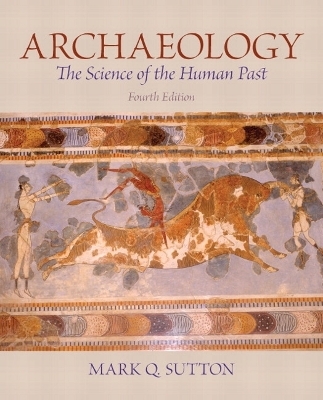
Archaeology
Pearson
978-0-205-89531-1 (ISBN)
- Titel ist leider vergriffen;
keine Neuauflage - Artikel merken
Packages
Access codes for Pearson's MyLab & Mastering products may not be included when purchasing or renting from companies other than Pearson; check with the seller before completing your purchase.
Used or rental books
If you rent or purchase a used book with an access code, the access code may have been redeemed previously and you may have to purchase a new access code.
Access codes
Access codes that are purchased from sellers other than Pearson carry a higher risk of being either the wrong ISBN or a previously redeemed code. Check with the seller prior to purchase.
--Illuminating the world of archaeology.
Archaeology conveys the excitement of archaeological discovery and explains how archaeologists think as they scientifically find, analyze, and interpret evidence. The main objective of this text is to provide an introduction to the broad and fascinating world of archaeology from the scientific perspective. Discussions on the theoretical aspects of archaeology, as well as the practical applications of what is learned about the past, have been updated and expanded upon in this fourth edition.
Learning Goals
Upon completing this book, readers will be able to:
Discuss the theoretical aspects of archaeology.
Apply what has been learned about the past.
Identify the various perspectives archaeologists have.
020589531X / 9780205895311 Archaeology: The Science of the Human Past Plus MySearchLab with eText -- Access Card Package
Package consists of
0205239927 / 9780205239924 MySearchLab with Pearson eText -- Valuepack Access Card
0205881793 / 9780205881796 Archaeology: The Science of the Human Past
Mark Q. Sutton began his career in anthropology in 1968. While still in high school, he took advantage of the opportunity to participate in archaeological excavations conducted by the local Community College. He went on to earn a BA (1972), an MA (1977), and a Ph.D (1987) in anthropology. He has worked as an archaeologist for the US Air Force, the US Bureau of Land Management, various private consulting firms, and taught at a number of community colleges and universities. He taught at California State University, Bakersfield from 1987 to 2007 where he retired as Emeritus Professor of Anthropology. He now works for Statistical Research, Inc. in San Diego. Dr. Sutton works on understanding hunter-gatherer adaptations to arid environments but has also investigated entomophagy, prehistoric diet and technology, and optimal foraging theory. Dr. Sutton has worked at more than 120 sites in North America and has published over 160 books, monographs, and papers on archaeology and anthropology.
In this Section:
1. Brief Table of Contents
2. Full Table of Contents
BRIEF TABLE OF CONTENTS:
Part 1: What is Archaeology?
Chapter 1: The Science of Archaeology
Chapter 2: Backgrounds of Archaeology
Chapter 3: The Development of Contemporary Archaeology
Part 2: Obtaining Information About the Past
Chapter 4: The Archaeological Record
Chapter 5: Conducting Fieldwork
Chapter 6: Classification and Analysis of Artifacts
Chapter 7: Determining Time
Chapter 8: Bioarchaeology: Human Remains
Part 3: Interpreting the Past
Chapter 9: Environment and Adaptation
Chapter 10: Understanding Past Settlement and Subsistence
Chapter 11: Interpreting Past Cultural Systems
Chapter 12: Understanding Culture Change
Part 4: Public Achaeology
Chapter 13: Cultural Resource Management
Chapter 14: Archaeology in the Real World
FULL TABLE OF CONTENTS:
Part 1: What is Archaeology?
Chapter 1: The Science of Archaeology
What Is Archaeology?
The Branches of Archaeology
Key Concepts in Archaeology
Archaeology as Science
The Importance of Archaeology
Chapter 2: Backgrounds of Archaeology
Ancient Archaeology
Antiquarians
The Discovery of Prehistory
The Emergence of Professional Archaeology
Developing the Outline of World Prehistory
Political Influences in the History of Archaeology
Chapter 3: The Development of Contemporary Archaeology
Archaeology after World War II
The Rise of Scientific Archaeology
Expanding Theoretical Horizons
Archaeological Frontiers
Careers in Archaeology
Part 2: Obtaining Information About the Past
Chapter 4: The Archaeological Record
Archaeological Sites
Archaeological Evidence
Site Formation and Transformation
Preservation
Recognizing and Recovering Evidence
Ongoing Impacts on the Archaeological Record
Chapter 5: Conducting Fieldwork
Finding Sites
Conducting Archaeological Surveys
Excavating Sites
Practical Aspects of Fieldwork
Ethics in Archaeological Fieldwork
Chapter 6: Classification and Analysis of Artifacts
Classification and Typology
Classifying Types of Artifacts
Analyzing Artifacts
Chapter 7: Determining Time
What Is So Important about Time?
Older or Younger? Relative Dating in Archaeology
Real Time: Chronometric Dating
Chapter 8: Bioarchaeology: Human Remains
The Study of Human Remains: Getting to Know Past Peoples
Preserved Bodies
Skeletal Remains
Analytical Approaches in Bioarchaeology
Part 3: Interpreting the Past
Chapter 9: Environment and Adaptation
The Environment
Environmental Archaeology
Human Biological Adaptation
Human Cultural Adaptation
Domestication and the Agricultural Revolution
Chapter 10: Understanding Past Settlement and Subsistence
How Did People Make a Living? Subsistence
Where Did People Live? Past Settlement Systems
The Interplay between Subsistence and Settlement
Chapter 11: Interpreting Past Cultural Systems
How Can Archaeology Answer Anthropological Questions?
Interpreting Past Social Structures
Interpreting Past Political Organization
Interpreting Past Belief Systems
Remembering the Individual
Chapter 12: Understanding Culture Change
The Archaeology of Change
Interpreting Evidence of Change
Cultural Contact and Conflict
Part 4: Public Achaeology
Chapter 13: Cultural Resource Management
The Impact of Population Growth and Development on Archaeology
The Field of Cultural Resource Management
The Role of Public Education in Archaeological Preservation
Cultural Resource Management among Traditional Peoples
Chapter 14: Archaeology in the Real World
Archaeology Today
Archaeology and Politics
Who Owns the Past?
Learning from the Past: Applying Archaeology to Contemporary Problems
Archaeology and Computer Technology
Archaeology, Mass Media, and Public Perception
So What? The Significance of Archaeology
| Erscheint lt. Verlag | 20.2.2013 |
|---|---|
| Sprache | englisch |
| Gewicht | 703 g |
| Themenwelt | Geisteswissenschaften ► Archäologie |
| Sozialwissenschaften ► Ethnologie | |
| Sozialwissenschaften ► Soziologie | |
| ISBN-10 | 0-205-89531-X / 020589531X |
| ISBN-13 | 978-0-205-89531-1 / 9780205895311 |
| Zustand | Neuware |
| Informationen gemäß Produktsicherheitsverordnung (GPSR) | |
| Haben Sie eine Frage zum Produkt? |
aus dem Bereich