


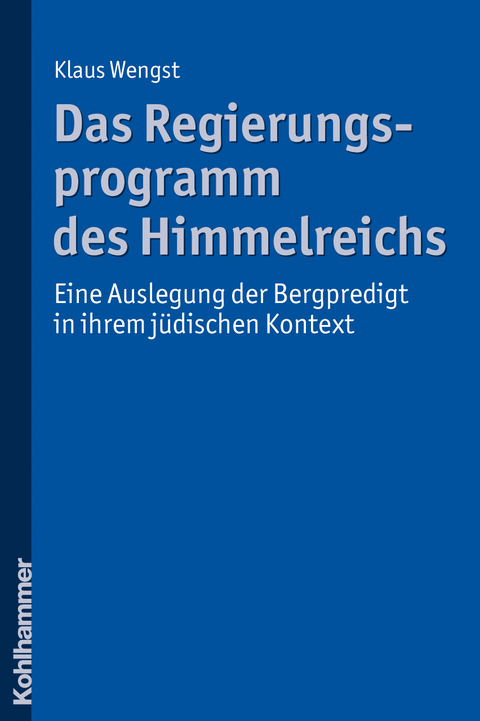
Das Regierungsprogramm des Himmelreichs
Eine Auslegung der Bergpredigt in ihrem jüdischen Kontext
Seiten
2010
Kohlhammer (Verlag)
978-3-17-021724-9 (ISBN)
Kohlhammer (Verlag)
978-3-17-021724-9 (ISBN)
- Titel erscheint in neuer Auflage
- Artikel merken
Zu diesem Artikel existiert eine Nachauflage
Jesu Lehre auf dem Berg - traditionell als Bergpredigt bezeichnet - ist ein zentraler Teil des Matthäusevangeliums. In dessen Gesamtkontext ist Jesus Lehrer, aber auch endzeitlicher Richter und König. So lässt sich die Bergpredigt als Regierungsprogramm des Messias Jesus verstehen. Sie soll umgesetzt werden von Jesu Schülerschaft, von der Gemeinde, geht aber intentional darüber hinaus. Am Ende des Evangeliums kommen "alle Völker" in den Blick: Nicht nur an Israel richtet sich Jesu Lehre, auch die Völker sollen mit Israel mitlernen. Dementsprechend erweist sich Jesus in seiner Lehre nicht als jemand, der "das Gesetz" überbietet oder abschafft, sondern er redet als Ausleger der Tora. Seine Aussagen stehen ganz und gar innerhalb des Judentums.
Diese Auslegung der Bergpredigt richtet sich nicht nur an TheologInnen, sondern will dazu beitragen, Jesu Lehre auf dem Berg auch einem breiteren interessierten Publikum neu zugänglich zu machen. Jesus' teaching on the mount - traditionally called Sermon of the Mount - is a central part of St. Matthew's Gospel. In its entire context Jesus is teacher, but also eschatological judge and king. Thus the Sermon of the Mount can be understood as governmental programme of the messiah Jesus. It is supposed to be set into practice by Jesus' followers, by the religious community, but surpasses this intentionally. At the end of the gospel all "peoples" are included: not only Israel but the peoples are addressed by Jesus' teaching. Accordingly Jesus proves to be someone who doesn't abolish or overbid the law, but speaks as an interpreter of the Tora. His declarations lie fully within Judaism.
This interpretation of the Sermon of the Mount isn't only aimed at theologians but adds to making Jesus teachings on the mount freshly available to a broad and interested audience.
Diese Auslegung der Bergpredigt richtet sich nicht nur an TheologInnen, sondern will dazu beitragen, Jesu Lehre auf dem Berg auch einem breiteren interessierten Publikum neu zugänglich zu machen. Jesus' teaching on the mount - traditionally called Sermon of the Mount - is a central part of St. Matthew's Gospel. In its entire context Jesus is teacher, but also eschatological judge and king. Thus the Sermon of the Mount can be understood as governmental programme of the messiah Jesus. It is supposed to be set into practice by Jesus' followers, by the religious community, but surpasses this intentionally. At the end of the gospel all "peoples" are included: not only Israel but the peoples are addressed by Jesus' teaching. Accordingly Jesus proves to be someone who doesn't abolish or overbid the law, but speaks as an interpreter of the Tora. His declarations lie fully within Judaism.
This interpretation of the Sermon of the Mount isn't only aimed at theologians but adds to making Jesus teachings on the mount freshly available to a broad and interested audience.
Prof. Dr. Klaus Wengst lehrt Neues Testament und Judentumskunde an der Universität Bochum.
Prof. Wengst teaches New Testament and Judaism studies at the University of Bochum.
| Erscheint lt. Verlag | 2.12.2010 |
|---|---|
| Verlagsort | Stuttgart |
| Sprache | deutsch |
| Maße | 160 x 240 mm |
| Gewicht | 386 g |
| Themenwelt | Geisteswissenschaften ► Religion / Theologie ► Judentum |
| Schlagworte | Bergpredigt • Judentum • Jüdische Theologie • Matthäusevangelium • Messias • Utopie |
| ISBN-10 | 3-17-021724-0 / 3170217240 |
| ISBN-13 | 978-3-17-021724-9 / 9783170217249 |
| Zustand | Neuware |
| Informationen gemäß Produktsicherheitsverordnung (GPSR) | |
| Haben Sie eine Frage zum Produkt? |
Mehr entdecken
aus dem Bereich

aus dem Bereich


